TRAINING ON DELIVERY OF PROJECTS THROUGH PUBLIC PRIVATE PARTNERSHIP
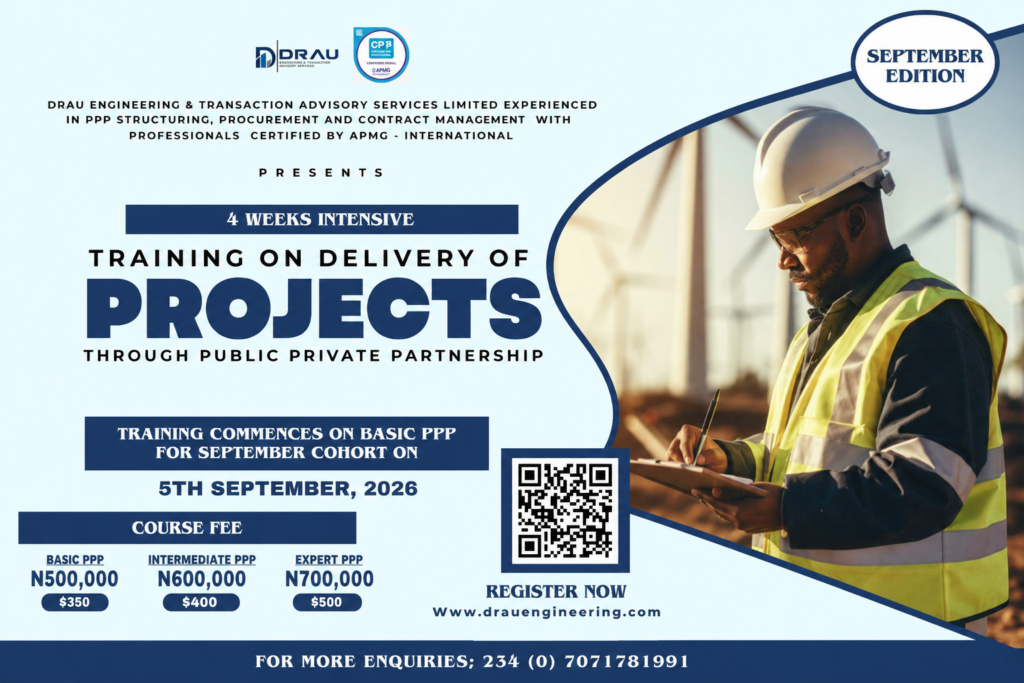
Public Private Partnership are one way to procure infrastructure and services and the PPP approach may provide significant benefits to the Government & Private if and when a number of conditions are met. In this way, the greatest possible value from this procurement option can be extracted in order to help countries to fill the infrastructure gap by accessing more private capital and expertise in an efficient and programmatic manner; this is especially true for Emerging Market and Developing Economy (EMDE) countries which Nigeria happens to be one of them.
In the mist of lean resources of Government & Private Sector, a comprehensive training program that encompasses various aspects of Public Private Partnership (PPP) are essential to position Chief Executive Officers (CEO) and the staff members of both Government & Private entities towards Planning and Executing a successful Public Private Partnership programme.
The training program would contain relevant topics such as Purpose of PPP, Characteristics of PPPs, Alternatives for infrastructure finance and procurement, what is PPP and what is not PPP, Types of PPP and nomenclature issues, Where PPPs are used: infrastructure sectors, Motivations for using PPPs: caveats, concerns and introduction to the PPP process cycle. The training programs care classified under Basic, Intermediate and Experts. Participants will issued Certificates at the end of the Training Program.
The duration for the training is 4 weeks (weekends)
Training Commences on Basic PPP for September Cohort on 5th September, 2026
COURSE FEE
Course Fee (Basic PPP) $350 or NGN500,000 equivalent per participant
Course Fee (Intermediate PPP) $400 or NGN600,000 equivalent per participant
Course Fee (Expert PPP) $500 or NGN 700,000 equivalent per participant
COURSE CONTENT -BASIC PPP
1. Introducing and scoping the PPP concept
- Definition of a PPP for the purpose of this PPP Guide.
- The main characteristics of a PPP
2. Alternatives for infrastructure finance and procurement. What is and what is not a PPP?
- The main conventional or publicly-financed procurement methods (for example, build; Design and Build [DB]; Engineering, Procurement and Construction [EPC] contracts) and what differentiates them from PPPs.
- Definition of a Design, Build, Finance, Operate and Maintain (DBFOM) project and how can it be funded (user-pays versus government-pays and variations).
- How service and/or existing infrastructure management contracts may or may not be PPPs (service PPPs).
- Understanding other private participation contexts and how they are neither PPPs nor procurement methods.
- How PPPs are different from other methods of procuring infrastructure.
3. Types of PPP and nomenclature issues
- How there may be different types of PPPs.
- How the PPP concept may vary amongst countries/jurisdictions and other terminology applied to the PPP concept.
4. Where PPPs are used: infrastructure sectors.
- Understanding the concept of public infrastructure and how it influences the PPP mode of procurement.
- Which sectors and projects are typically appropriate for PPPs?
5. Motivations for using PPPs: caveats, concerns and introduction to the PPP process cycle.
- The reasons or motivations usually cited for using PPPs.
- The typical pitfalls and caveats to consider when using PPPs.
- Why sound selection, preparation and transparent tender processes matter.
- How the framework plays a role in promoting and protecting a successful PPP approach.
- How and why some EMDE, especially the Least Developed Countries (LDC), may find difficulties in developing PPPs.
6. Typical structure of a PPP
- The main elements of a PPP contract and the different roles of the various parties involved.
- The structure of a PPP contract: upstream structure and downstream structure.
- The “payment mechanism” and what it does.
- How structuring the PPP matters and how the private partner needs to work to meet its obligations.
- The main structures in terms of scope to be found in the most common PPP sectors.
7. How PPPs are financed.
- Typical sources of funds and types of PPPs depending on the origin of funding (including co-financed PPPs).
- The role of Multilateral Development Banks (MDBs) and other development institutions such as Export Credit Agencies (ECAs).
- Considerations for the procuring authority regarding financial aspects.
- Potential pitfalls and concerns.
8. Reasons for Project failure: the need for sound process management and preparation of projects.
- What constitutes a successful project and why projects may fail.
- What a private partner is looking for in terms of acceptable projects.
9,. Introduction to the PPP framework concept and initial framework consideration
10. Class Evaluation