REVIVING NIGERIA’S REFINERY THROUGH PUBLIC PRIVATE PARTNERSHIP
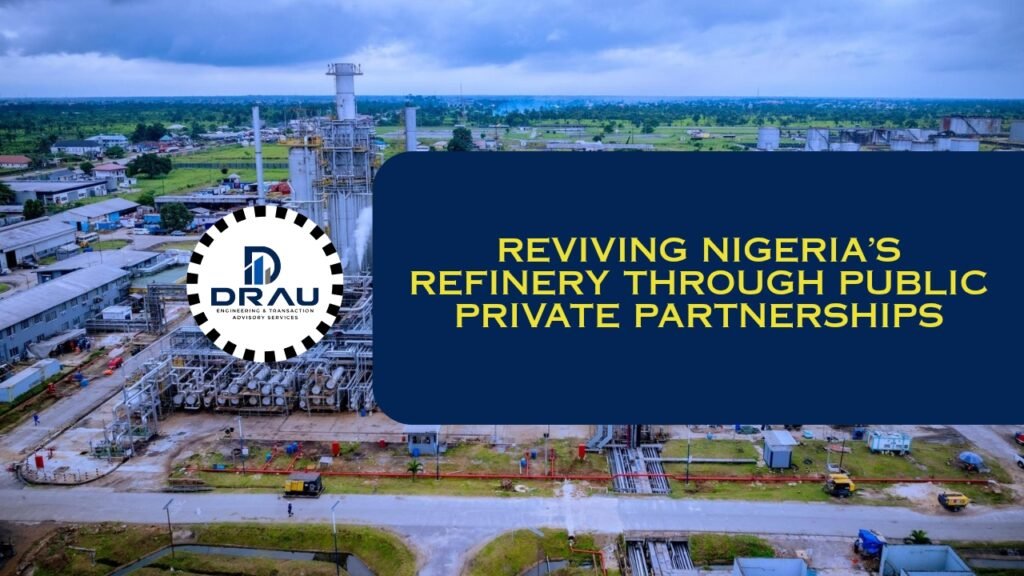
Let us look at how Public Private Partnerships (PPPs) could be used to make Nigeria’s refinery work again. Public-Private Partnership is one way to procure infrastructure especially when the various feasibility indicates that the project could be commercially viable and provides Value for Money when compared to the traditional procurement methods.
Also read: PRIVATIZATION VS PUBLIC PRIVATE PARTNERSHIP
The good thing about PPPs is that it could be used to delivery infrastructure at various condition of the project site such as Green Field, Brown Field and Yellow Field.
Green Field Project: The is a project investment that is related to Design, Build, Finance, Operate and Maintain (DBFOM) the infrastructure for a given period of time.
Brown Field Project: This refers to project investment that is already in existence before the time of procurement or the infrastructure was previously greenfield but operational as at time which the procurement was made.
Yellow Field Project: In this type of Investment, there is usually significant renewals, refurbishment and sometime substantial expansion of the existing infrastructure.
CURRENT STATE OF THE NIGERIA’S REFINERY
Nigeria owns four (4) refineries namely; Warri Refinery, Kaduna Refinery, Old and New Port Harcourt Refinery. In line with the classification above, these refineries are under Yellow Field Project Not as Brown Field because they are not currently operational. This implies that significant renewals and substantial expansion are required to make these refineries work again. Therefore, if these infrastructures were to be procured using the PPP route, it would be classified as Yellow Field Project.
HOW TO MAKE THE REFINERIES WORK AGAIN USING THE PUBLIC PRIVATE PARTNERSHIP ROUTE
Project Identification;
Having identified that the current state of the refineries is at various stages of Yellow Field, the next stage is to access if the project has sufficient economic reasons/merit to proceed as PPP to avoid sinking in resources into analysis and structuring of a non-feasible project i.e., checking if procuring the refineries through PPP will provide economic benefits or will be efforts in futility. Other activities to be carried out is identifying technical solutions on existing problems in the refinery. Other activities such as clarifying the technical scope, check if the parts are available with Original Equipment Manufacturer (OEM) and provision of detailed description and requirements of the refineries. Another check include testing if the project makes economic sense and it is sound to be carried out as PPP. This could be achieved using Cost-Benefit-Analysis (CBA). On the government side, the project has to be tested if it makes sense being procured as a PPP (PPP suitability). Government should also check if it could afford the project i.e. if the project will be derisk at any point in time i.e. check if the project would require viability gap funding/grant financing or other forms of guarantee. Once these parameters have been confirmed and result is satisfactory and the staffing plan has been concluded including appointment of a Transaction Adviser to assist in development of the feasibility studies, then a checklist is developed to fully determine if the project could proceed to the appraisal stage. The Checklist will contain elements such as the Project name, technical features of the project, Capital Expenditure (CapEx), Terms of Rehabilitation, Operational Expenditure (OpEx), user fees to be charge, Revenue Estimates, main economic impact, potential interest from private sector, site availability, environmental considerations, and any other information necessary to move the project to the next stage of project appraisal.